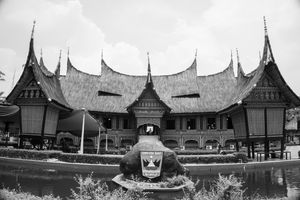

Minangkabau matriarchy is the foundational social structure of the Minangkabau people in West Sumatra, Indonesia, representing the largest matrilineal society in the modern world. In this system, family names, ancestral land, and traditional titles are passed down from mothers to daughters, rather than through the paternal line. This cultural identity is most visibly expressed in the Rumah Gadang, or "big house," an architectural marvel characterized by its dramatic, upward-curving roofs that mimic the horns of a water buffalo. These structures serve as the physical anchors for a clan, housing multiple generations of women and their families under a single, soaring canopy of thatch and timber.
In the highland regency of Tanah Datar, the air carries a distinct coolness that rolls down from the peaks of Mount Marapi. Here, the Rumah Gadang stands as a testament to a social order that has survived centuries of colonial pressure and religious shifts. The building is not merely a residence but a living diagram of the Minangkabau worldview, known as Adat. Every pillar, every carved leaf on the exterior walls, and every tier of the roof corresponds to a specific law of the matriarchy. To see a Rumah Gadang is to see the family tree of a clan rendered in solid oak and bamboo.
The Origins and Meaning of Minangkabau Matriarchy
The roots of the Minangkabau matriarchy are tied to the legendary figure of Bundo Kanduang, the mythical queen who embodies the ideal of the wise and nurturing mother. Unlike many other societies where women are moved into the husband's household upon marriage, the Minangkabau practice matrilocality. When a man marries, he moves into the Rumah Gadang of his wife’s family. He becomes a guest in her home, while the ownership of the house and the surrounding rice fields remains firmly in the hands of the women.
This system ensures that women are never left without economic security. If a marriage ends in divorce or a husband passes away, the woman retains her home and her livelihood. The men, meanwhile, are encouraged to travel, a tradition known as merantau. They leave the village to seek fortune, education, and experience in distant lands, returning later to contribute their wealth and knowledge to their mother's or sisters' households. This dynamic has created a society that is both deeply rooted in local tradition and remarkably cosmopolitan, as the men bring back ideas from across the globe while the women maintain the stability of the ancestral hearth.
Adat, the customary law of the Minangkabau, dictates that "nature is our teacher." This philosophy is the reason the architecture reflects the natural world. The name Minangkabau itself is often translated as "winning buffalo," stemming from a legend where a local calf defeated a giant Javanese buffalo through cleverness. This victory is immortalized in the gonjong, the sharp, horn-like points of the roof that pierce the West Sumatra skyline. These peaks are more than decoration. They are a constant reminder of the community's resilience and their clever navigation of history.

Architectural Features of the Rumah Gadang
The construction of a Rumah Gadang is a feat of engineering that requires no nails. Instead, the master builders use a sophisticated system of mortise and tenon joints, secured with wooden pegs. This flexibility is essential in West Sumatra, a region prone to frequent and powerful earthquakes. When the ground shakes, the house does not crack. It sways, absorbing the energy of the earth through its heavy timber frame. The entire structure sits on flat stones rather than being sunk into the ground, allowing the building to shift and settle without collapsing.
| Feature | Symbolic Meaning |
|---|---|
| Gonjong (Roof Peaks) | Buffalo horns, representing strength and the legend of the winning buffalo. |
| Tiang (Pillars) | The strength of the family lineage and the support of the clan. |
| Rangkiang (Rice Barns) | Prosperity, food security, and the wealth of the female head of house. |
| Ukiran (Carvings) | Lessons from nature, such as growth, persistence, and harmony. |
A typical house is rectangular and divided into longitudinal sections called lanjar. The number of rooms is determined by the number of women in the family. When a daughter marries, a new room, or bilik, is often added to the end of the house. This makes the Rumah Gadang a modular entity, growing and breathing along with the lineage it protects. The front of the house is always reserved for the communal hall, where the family gathers to discuss matters of law, marriage, and inheritance under the guidance of the eldest female, the Bundo Kanduang of the house.
West Sumatra Architecture: A Reflection of Customary Law
The layout of West Sumatra architecture is a physical map of social hierarchy. The floor is often built at different levels. The ends of the house, known as anjung, are frequently raised higher than the central section. These elevated spaces were historically reserved for the inauguration of clan leaders or for the eldest women to sit during ceremonies. To move through the house is to move through different grades of social importance, though the entire space remains fundamentally communal.
Light enters the Rumah Gadang through small windows, illuminating the intricate carvings that cover the exterior. These carvings, known as ukiran, are never depictions of humans or animals, in accordance with Islamic tradition. Instead, they are stylized patterns of flowers, leaves, and vines. Each pattern has a name and a corresponding proverb. The "bamboo shoot" pattern, for instance, represents the idea that one should be useful to society at every stage of life, just as a bamboo plant is used for food when young and for construction when old. These walls are not just partitions; they are textbooks of morality and social conduct.
Outside the main house, one invariably finds the rangkiang. These are smaller, highly decorated granaries used to store the rice harvest. In the Minangkabau matriarchy, the management of the food supply is a female prerogative. The Bundo Kanduang decides how much rice is saved for the family, how much is kept for seeds, and how much is given to the poor. The presence of a full rangkiang is the ultimate sign of a successful and well-managed household, indicating that the women of the clan have secured the future for another year.

Symbols and Carvings in Rumah Gadang History
To understand Rumah Gadang history, one must look closely at the color palette used in the carvings. Red represents the courage of the people. Yellow symbolizes the law and the royalty of the ancient Pagaruyung Kingdom. Black represents the penghulu, or the male clan leaders who act as the guardians of the Adat. These three colors together form the Marawa, the flag of the Minangkabau, which flutters at the entrance of every traditional village.
The history of these buildings is also a history of survival. During the colonial era, the Dutch attempted to undermine the matrilineal system, viewing it as a threat to patriarchal administrative structures. Later, during the regional rebellions of the 1950s, many traditional houses were burned or abandoned. However, the symbolic power of the Rumah Gadang was too strong to be erased. In the 1970s and 80s, a cultural revival led to the restoration of grand sites like the Pagaruyung Palace, which, despite being destroyed by fire multiple times, has been rebuilt with faithful attention to the original geometry of the matriarchy.
Walking through a village like Nagari Pariangan, which is often cited as the cradle of Minangkabau culture, the observer sees houses in various states of age. Some are blackened with centuries of smoke and weather, their thatch roofs replaced by corrugated zinc that has rusted into a deep orange. Others are freshly painted, their carvings gleaming with gold leaf. Regardless of their age, the orientation remains the same. They face the road or the river, open to the community, while their backs are turned toward the mountains, providing a sense of protection and privacy for the women living within.
Life Inside the Matrilineal Home
Inside the communal hall, the atmosphere is one of shared responsibility. During a wedding, the space is transformed into a vibrant theatre of silks and brassware. The men sit in rows facing one another, engaging in a formal, rhyming dialogue known as pasambahan. They negotiate the terms of the union and the exchange of symbolic gifts. However, the invisible hand guiding the entire event belongs to the women in the back rooms. They prepare the elaborate feasts and ensure that every protocol of the lineage is followed to the letter.
For the young boys of the village, the Rumah Gadang is a place of transition. Once they reach a certain age, they no longer sleep in the big house. Instead, they move to the surau, a communal prayer house or mosque. This practice encourages independence and prevents the "guest" males from becoming too comfortable in the female-dominated space. It is in the surau that they learn the Quran and the art of Silek, the traditional Minangkabau martial art. This separation of spaces ensures that the Rumah Gadang remains a sanctuary for the women and their children, a place where the maternal line is never diluted.
Modernity has brought changes to these interiors. You might see a television set resting on a hand-carved chest or a laptop plugged into a socket beside a traditional weaving loom. Yet, the social core remains. Even families who have moved to Jakarta or abroad for work will return to their ancestral Rumah Gadang for the Eid holidays. They come to pay respects to the eldest matriarch and to reaffirm their place in the clan. The house acts as a compass, always pointing the Minangkabau back to their matrilineal origins, no matter how far they have wandered.

Preserving the Minangkabau Matriarchy in the Modern Era
The survival of the Rumah Gadang depends on more than just physical maintenance. It requires the continued relevance of the matrilineal system in an increasingly globalized world. As younger generations move into modern, individualistic housing, the cost and labor required to maintain a massive timber structure with a thatch roof can be prohibitive. A single roof replacement can cost thousands of dollars and requires specialized craftsmen who are becoming increasingly rare.
Fortunately, there is a growing movement in West Sumatra to preserve these structures as symbols of ethnic pride and as assets for cultural tourism. Government initiatives and private foundations are working to document the architectural techniques and to provide subsidies for families who choose to live in and maintain their ancestral homes. The architecture of the Minangkabau is not a relic of the past; it is a functional, beautiful solution to the challenges of living in a seismic zone and a profound expression of a society that values the strength and continuity of women.
As the afternoon sun dips below the horizon, casting long shadows across the village square, the silhouettes of the buffalo-horn roofs stand sharp against the purple sky. They are reminders that architecture is never just about shelter. In the highlands of West Sumatra, the Rumah Gadang is a declaration of identity. It is a geometry of respect, a monument to the mother, and a enduring testament to the Minangkabau matriarchy that continues to thrive in the modern age.
People Also Ask
What is Minangkabau matriarchy?
Minangkabau matriarchy is a social system in West Sumatra where lineage, inheritance, and property are passed down through the female line. It is the largest matrilineal society in the world, balancing traditional customary law with Islamic practice.
Why do Rumah Gadang roofs look like buffalo horns?
The roofs, known as gonjong, are designed to resemble buffalo horns to honor the legend of the "winning buffalo" that gave the Minangkabau people their name. They also symbolize the community's connection to nature and their resilience.
Who inherits the Rumah Gadang in Minangkabau culture?
The house and all ancestral property are inherited by the daughters of the family. The eldest female, or Bundo Kanduang, typically manages the household, ensuring that the property remains within the female bloodline for generations.
How are Rumah Gadang houses built to survive earthquakes?
Rumah Gadang are built using flexible wood-to-wood joints without nails, allowing the structure to sway during tremors. The entire building sits on large stones rather than being anchored in the ground, preventing the frame from snapping during seismic activity.
Can men own property in Minangkabau society?
While ancestral land and houses belong to women, men can own "earned property" which they acquire through their own work or business. However, traditional titles and clan lands are strictly reserved for the matrilineal inheritance system.
Where is the best place to see authentic West Sumatra architecture?
The most authentic examples of Rumah Gadang can be found in the Tanah Datar and Agam regencies. The Pagaruyung Palace in Batusangkar and the traditional village of Nagari Pariangan are primary sites for observing this architecture.