
Batik Parang meaning refers to the spiritual and social hierarchy encoded within the diagonal rows of the Javanese knife-like patterns. This specific design serves as one of the oldest and most revered motifs in the Indonesian archipelago, symbolizing power, authority, and the relentless pursuit of self-improvement. Inside the darkened halls of the Kraton Yogyakarta, the rhythmic scratching of a copper canting against taut silk creates a steady tempo. The air carries the heavy, sweet scent of molten beeswax mixed with pine resin. Here, the creation of batik is not merely a craft but a form of meditation, where every line drawn represents a prayer or a decree.
For centuries, the Parang pattern was classified as Awisan Dalem, or the forbidden cloth. These were designs reserved exclusively for the Sultan, his family, and the high nobility of the courts of Surakarta and Yogyakarta. To wear the Parang was to claim a connection to the divine right of kings. The motif consists of parallel diagonal lines containing repeating "S" shapes, often described as stylized waves or the blade of a kris dagger. This geometry is not accidental; it reflects a Javanese world view where continuity and balance are the foundations of a stable universe.

Understanding the Batik Parang Meaning and Its Philosophical Roots
The word Parang originates from the Javanese word pereng, which translates to slope or mountainside. This linguistic root hints at the diagonal orientation of the pattern, which must always run at a forty-five-degree angle. The visual flow of the motif mimics the motion of waves crashing against the jagged rocks of the southern coast of Java. Legend attributes the creation of the first Parang pattern to Sultan Agung of Mataram during the 17th century. It is said that while meditating on the shores of Parangtritis, the Sultan was inspired by the relentless energy of the Indian Ocean, seeing in the waves a metaphor for the unyielding spirit a leader must possess.
At its core, the Batik Parang meaning centers on the concept of continuity. The "S" shapes are interlocked in a way that suggests an unbroken chain. In Javanese philosophy, this represents the idea of lanjur, or the continuous flow of life and ancestral wisdom. A ruler who wears the Parang is reminded that their authority is a link between the past and the future. The pattern demands that the wearer maintains a straight path, as the diagonal lines require absolute precision during the wax application process. Any deviation in the line is seen as a flaw in the character of the maker or the wearer.
Beyond the physical representation of waves, the motif also symbolizes the kris, the traditional Javanese dagger. The sharp edges within the pattern signify power and the ability to discern right from wrong. However, this power is tempered by the softness of the curves, suggesting that a true leader must be both strong and compassionate. The interaction between the dark indigo dyes and the warm, earthy soga brown creates a visual harmony that mirrors the Javanese ideal of emotional restraint and inner peace.
The Hierarchy of the Forbidden Patterns
The strict regulation of Batik Parang was a defining feature of Javanese court life for generations. Not all Parang motifs are created equal; the size and complexity of the design traditionally dictated the rank of the wearer. This system of textile protocol ensured that the social order was visible at a glance during royal audiences or state ceremonies. The most significant of these variations is the Parang Barong, characterized by its large scale, where each individual motif can exceed ten centimeters in length.
| Pattern Name | Scale of Motif | Traditional Status |
|---|---|---|
| Parang Barong | 10cm to 20cm | Reserved strictly for the Sultan (Ruler) |
| Parang Rusak | 5cm to 10cm | High Nobility and Crown Princes |
| Parang Slobog | Medium | Used for funerals and rites of passage |
| Parang Klithik | Small (under 5cm) | Royal ladies and younger family members |
| Parang Kusumo | Medium | Symbolizing the bloom of nobility; used in weddings |
Parang Barong takes its name from the lion-like creature of Javanese and Balinese mythology, signifying the supreme power of the monarch. When the Sultan wears this pattern, he is visually manifesting his role as the protector of the realm. The scale of the pattern is meant to be imposing, a reminder that the king's responsibilities are larger than those of any individual. In contrast, Parang Rusak, which translates to "broken parang," features a more intricate and jagged aesthetic. It represents the struggle against one's own base desires and the refinement of the soul through internal conflict.

The Alchemy of the Canting: A Living Craft
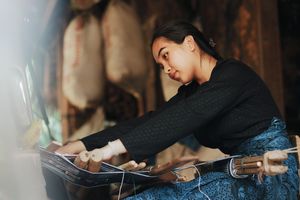
The production of an authentic, hand-drawn Batik Tulis Parang is a process that defies the modern pace of life. It begins with high-quality mori cloth, usually fine cotton or silk, which is washed and beaten to soften the fibers. The artisan, known as a pembatik, sits before a frame called a gawangan. Using a canting—a small copper tool with a bamboo handle and a delicate spout—the artist traces the intricate patterns with liquid wax. The wax acts as a resist, preventing the dye from penetrating the covered areas.
Consistency is the greatest challenge when creating Parang. Unlike floral or organic motifs that allow for slight variations, the geometric precision of the Parang requires a steady hand and an almost mathematical focus. The artist must maintain a constant temperature for the wax; if it is too hot, it will bleed through the cloth and ruin the sharp edges; if it is too cold, it will not adhere properly. This stage of the process, called nglowong, can take weeks or even months for a single piece of cloth. Each line must be drawn on both sides of the fabric to ensure the color remains vibrant and the pattern is perfectly aligned.
Once the waxing is complete, the cloth undergoes multiple dye baths. Traditionally, Javanese batik uses natural dyes derived from the bark of the soga tree (Peltophorum pterocarpum) for brown tones and the leaves of the indigo plant for blues. The process of dipping, drying, and scraping away the wax (nglorod) is repeated until the desired depth of color is achieved. The final result is a textile that carries the weight of history and the personal energy of the artisan. In the villages surrounding Yogyakarta, such as Giriloyo, these techniques are passed down through maternal lines, preserving a vocabulary of symbols that has remained largely unchanged for four hundred years.
Rituals and Transitions: Parang in Javanese Life
While the legal prohibitions on wearing Parang have relaxed in modern Indonesia, the pattern remains deeply embedded in the ritual life of the Javanese people. It is particularly prominent during the Siraman ceremony, a ritual bathing that takes place before a wedding. The bride and groom often wear specific variations of Parang to symbolize their transition into a new stage of life. The Parang Kusumo, for instance, is a popular choice for these occasions, as it represents the "flowering" of a new generation and the hope for a fruitful marriage.

In the context of the Kraton, the Parang still holds its sacred status during the Labuhan ceremony, an annual offering to the spirits of the volcanoes and the sea. Pieces of batik are among the items offered to the Queen of the South Sea, Nyi Roro Kidul, to maintain the cosmic balance between the land and the water. This act reinforces the Batik Parang meaning as a bridge between the physical world and the spiritual realm. The cloth is not just clothing; it is a talisman, a protective layer that aligns the wearer with the natural laws of the universe.
Even in contemporary Jakarta boardrooms or international diplomatic circles, a high-quality Parang shirt or sarong commands a specific type of respect. It signals an appreciation for heritage and a commitment to the values of discipline and continuity. Modern designers continue to reinterpret the Parang, scaling it down for high fashion or abstracting its lines for digital prints, yet the foundational "S" curve remains recognizable. It is a testament to the strength of the original design that it can survive the transition from a royal decree to a global symbol of Indonesian identity.
The Eternal Wave
To look at a piece of Batik Parang is to see the history of Java folded into the fibers of a cloth. The pattern does not end; it simply flows off the edge of the fabric, suggesting an infinite extension of the same energy. This is the ultimate Batik Parang meaning: the recognition that power is not a static possession but a moving force that must be channeled with wisdom and grace. As the sun sets over the courtyards of the Kraton, casting long shadows across the stone floors, the sight of a courtier moving in a Parang sarong is a reminder that some traditions do not merely survive; they breathe. The forbidden cloth continues to tell its story, one wax-drawn line at a time, ensuring that the philosophy of the ancient kings remains a living part of the modern world.
People Also Ask
What does the Batik Parang pattern symbolize?
The pattern symbolizes the power of nature, specifically the ocean waves, and the spiritual strength required by a leader. It represents continuity, an unbroken link to ancestors, and the constant struggle to improve one's character.
Why was Batik Parang once forbidden?
It was classified as Awisan Dalem, meaning it was reserved for the Sultan and the royal family. This was to ensure that the social hierarchy was clearly visible and to maintain the sacred nature of the motifs associated with the divine right of kings.
Can tourists and commoners wear Batik Parang today?
Yes, outside of the royal palaces, there are no legal restrictions on wearing Parang. However, it is still considered respectful to avoid wearing large-scale Parang Barong when visiting the Kraton in Yogyakarta or Surakarta, as these remain traditionally reserved for the Sultan.
How can you distinguish between Yogyakarta and Surakarta styles of Parang?
Yogyakarta batik typically features a stark white background with bold, dark brown and indigo patterns. Surakarta (Solo) batik tends to have a yellowish or cream background with more delicate, softer brown tones.
What is the significance of the "S" shape in the design?
The "S" shape, or the laler, represents the wave or the blade of a kris. Its interlocking nature signifies the flow of life and the idea that one action leads to the next in an eternal cycle.
How is authentic hand-drawn batik parang made?
Authentic batik, known as Batik Tulis, is made by applying hot wax to cloth using a copper tool called a canting. The cloth is then dyed in multiple stages, with the wax acting as a resist to create the intricate, sharp-edged patterns.