
Clouds gather over the Simarjarunjung ridge, heavy with the moisture of the North Sumatran rainforest. Below, the surface of Lake Toba stretches into the distance, a vast expanse of blue that looks more like a sea than a mountain lake. The water is still, reflecting the steep walls of the caldera that rise nearly a kilometer from the shoreline. This quiet landscape masks a history of unimaginable violence. Seventy-four thousand years ago, the earth beneath this spot opened up in a super-volcanic eruption that changed the trajectory of life on Earth. Today, the ancestors of those who survived have built a vibrant culture within the footprint of that cataclysm, living on the very land that the volcano pushed back toward the sky.
The scale of the Toba caldera is difficult to grasp from the ground. It measures one hundred kilometers long and thirty kilometers wide, a footprint large enough to be seen clearly from orbit. It is not just a lake. It is a scar left by the Youngest Toba Tuff eruption, an event that ejected two thousand eight hundred cubic kilometers of volcanic material into the atmosphere. The sky turned gray for years. Global temperatures plummeted, creating a volcanic winter that some geneticists believe reduced the human population to just a few thousand individuals. This genetic bottleneck shaped the modern human genome, making every person alive today a descendant of the few who endured the cold and ash of the Toba winter.
The Physics of a Collapsed World
Geology here is not a silent backdrop but a dominant force. When the magma chamber beneath the ancient Toba volcano emptied during the Great Eruption, the roof of the mountain collapsed into the void. This created the massive depression now filled by the lake. However, the story did not end with the collapse. In the millennia that followed, the pressure of new magma rising from deep within the earth pushed the floor of the caldera upward. This geological phenomenon, known as a resurgent dome, created Samosir Island. Samosir is an island within an island, a massive block of the earth's crust that was lifted out of the water, tilting slightly to the west.
Walking along the eastern cliffs of Samosir, one can see the layers of history exposed in the rock. The cliffs are sheer and vertical, dropping directly into the deepest parts of the lake, which reach depths of over five hundred meters. The water is exceptionally clear, filtered by the volcanic rock and fed by mountain streams. Unlike many tropical lakes, the air here is cool and crisp, a relief from the humid heat of the Sumatran lowlands. The temperature rarely exceeds twenty-five degrees Celsius, making it an ideal environment for the pine trees that line the ridges, their scent mixing with the faint smell of sulfur from distant hot springs.

At the northern end of the lake, near the village of Pangururan, the earth still breathes. Hot springs bubble up from the base of Mount Pusuk Buhit, a sacred peak for the local Batak people. The water is rich in minerals, staining the rocks yellow and white. Visitors often soak in these thermal pools as the sun sets behind the caldera rim, watching the light turn the lake into a sheet of hammered silver. It is a reminder that while the supervolcano is dormant, the heat that created it remains just a few kilometers beneath the surface.
Architects of the Highlands
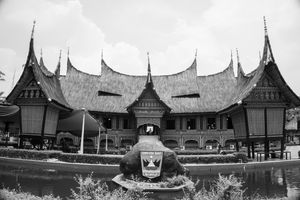
The Batak Toba people, the primary inhabitants of this region, have developed a culture that is as sturdy and resilient as the volcanic soil they till. Their arrival in the caldera is recorded in oral histories and genealogies known as tarombo, which trace every family back to a common ancestor at Pusuk Buhit. Their architecture is perhaps the most striking visual element of the landscape. The traditional Batak house, or Jabu Bolon, is a masterpiece of wooden engineering. These houses are built on massive stilts, with roofs that curve upward like the hull of a ship, a design intended to mimic the horns of the water buffalo.
Each Jabu is built without a single nail, using wooden pegs and fibers from the sugar palm tree to bind the structure together. The orientation is always intentional, aligned with the cardinal directions and the flow of the mountains. The exterior is decorated with intricate carvings in three colors: red, black, and white. These colors represent the three realms of the Batak cosmos: the underworld, the world of humans, and the heavens. The carvings often feature the 'boraspati', a lizard motif that symbolizes fertility and protection, along with stylized breasts that represent the nurturing power of the mother.

Inside, the houses are smoky and dark, with a central hearth that provides warmth during the chilly highland nights. There are no rooms in the traditional sense. The space is communal, divided by social protocols rather than walls. Life is lived in the open, on the broad verandas or in the stone-paved courtyards of the huta, or village. The village structure is defensive, a remnant of a time when the highlands were a collection of warring chiefdoms. Today, these villages are open and welcoming, though the sense of communal identity remains fiercely strong.
The Soil and the Sacred Cloth
Agriculture is the lifeblood of the caldera. The volcanic ash that once threatened to extinguish humanity has, over tens of thousands of years, weathered into some of the most fertile soil on the planet. On the slopes of Samosir and the surrounding plateaus, farmers grow shallots, garlic, and coffee. The Arabica coffee from this region, often processed using the unique 'giling basah' or wet-hulling method, is prized globally for its heavy body and earthy, spicy notes. To see the harvest is to see the rhythm of the seasons. In the early morning, the hills are dotted with the conical bamboo hats of workers moving through the green rows of coffee trees.
Beyond the fields, the Batak people maintain a profound connection to the spiritual world through the weaving of Ulos. This sacred cloth is more than just a garment. It is a vessel for blessings. An Ulos is given at every major transition in life: birth, marriage, and death. The weaving is done exclusively by women, using backstrap looms that require the weaver to use her own body weight to tension the threads. The process is slow and meditative, often taking weeks to complete a single piece.

In the village of Lumban Suhi-Suhi, the rhythmic click of the looms provides a constant soundtrack to daily life. The patterns are geometric and symbolic, representing the stars, the mountains, and the lineage of the family. To watch a woman weave an Ulos is to watch the preservation of a history that predates the arrival of outside religions. While most Batak Toba are now devout Christians, their lives are still governed by 'adat', a complex system of traditional laws and customs that dictate how individuals relate to one another and to the land. The Ulos remains the physical manifestation of this adat, a warm weight on the shoulders during a wedding or a final shroud for the deceased.
Navigating the Crater
Reaching Lake Toba requires a journey that transitions from the chaotic urban sprawl of Medan to the serene heights of the Barisan Mountains. For those arriving from the coast, the road climbs steadily, winding through rubber and palm oil plantations before reaching the pine-clad ridges of the highlands. A newer gate to the region is Silangit International Airport, located on the southern edge of the caldera. Landing here is a dramatic experience, as the plane descends over the green expanse of the lake, providing a bird's-eye view of the sheer scale of the crater.
From the town of Parapat, ferries depart regularly for Samosir Island. The crossing takes about forty-five minutes, offering a perspective of the caldera walls that is impossible to get from the shore. The ferries are often crowded with motorbikes, baskets of produce, and local musicians playing guitars and singing 'Tapanuli' songs. The Batak are famous throughout Indonesia for their powerful voices and love of harmony. On the ferry, it is common to hear a group of men spontaneously break into a four-part harmony, their voices carrying over the sound of the engine and the splashing of the water.

For the traveler, Samosir is best explored on two wheels. The perimeter road circles the island, passing through small hamlets where children wave from the porches of traditional houses. The interior of the island rises to a high plateau, where there are smaller lakes, such as Lake Sidihoni, effectively a lake on an island in a lake. These upland areas are quiet and lonely, home to grazing water buffalo and the occasional shepherd. The air here is thinner and cooler, and the view of the surrounding caldera rim is a constant reminder of the geological forces that created this sanctuary.
Practical Considerations for the Highland Traveler
Traveling in the Toba region requires a shift in pace. The climate is much cooler than the rest of Sumatra, so a sturdy jacket and layers are essential, especially for the early mornings and late evenings. The rainy season typically runs from October to January, bringing heavy afternoon downpours that can turn the mountain roads slippery. The dry months of May through September offer the clearest skies and the best views of the caldera.
While Indonesian is widely spoken, learning a few phrases in the Batak language, such as 'Horas', the universal greeting and blessing, goes a long way in establishing a connection with the locals. Logistics are straightforward but require time. Renting a motorbike on Samosir is the most flexible way to see the island, but the roads can be steep and winding. For those seeking a deeper cultural experience, staying in a converted traditional house in the village of Tomok or Tuktuk allows for a more immersive encounter with the rhythms of Batak life.
A Landscape of Resilience
The story of Lake Toba is one of transformation. What was once the site of a global catastrophe has become a place of profound beauty and cultural depth. The Batak people do not live in fear of the volcano. Instead, they have integrated its legacy into their identity. They have built their tombs on the high ridges, overlooking the water, ensuring that their ancestors continue to watch over the caldera. They have turned the volcanic soil into a garden and the volcanic rock into the foundations of their homes.
Standing on the edge of the rim as the mist clears, the sheer scale of the landscape is humbling. The water is deep, the mountains are high, and the history is measured in tens of thousands of years. Life here is a testament to the ability of both the earth and its people to recover from the most violent of beginnings. The caldera is no longer a wound, but a cradle, holding within its walls a culture that is as enduring as the basalt cliffs that surround it.