
In the highlands of West Sumatra, where the air remains cool even as the sun climbs high, a specific scent defines the rhythm of the afternoon. It is the smell of coconut milk reaching its breaking point, the sharp sting of ginger, and the grounding weight of scorched wood. In a small kitchen outside Bukittinggi, an iron wok sits over a low flame. Inside, what began as a pale, liquid stew has slowly transformed over several hours into something dark, dense, and oily. This is not merely a meal. For the Minangkabau people, the creators of this dish, the slow reduction of beef and spices is a profound act of cultural preservation. It is a philosophy that can be tasted.
Rendang is often mislabeled in global culinary circles as a curry. To the people of the Darek highlands, calling rendang a curry is like calling a diamond a piece of coal. A curry is defined by its liquid, a fleeting sauce meant to be consumed within hours. Rendang, however, is defined by the absence of moisture. It is a dish born of necessity, designed to endure the tropical heat of the Indonesian archipelago without the aid of refrigeration. The process is a physical manifestation of patience, requiring a cook to stand by the flame for half a day, stirring constantly to ensure the sugars in the coconut milk caramelize rather than burn. This endurance reflects the very soul of the Minangkabau, a society where wisdom is measured by one’s ability to wait for the right moment.
The Alchemy of the Four Pillars
To understand the Minangkabau is to understand the Musyawarah, or the tradition of communal consensus. This social structure is mirrored precisely in the four primary components of a proper rendang. Each ingredient carries a weight that extends far beyond its flavor profile, representing a specific pillar of their matrilineal society. The meat, or daging, is the foundation. It represents the Niniak Mamak, the traditional clan leaders and elders who provide stability and direction to the community. Just as the beef must be tough enough to withstand hours of intense heat without disintegrating, the elders must remain resilient under the pressures of leadership.

Supporting this foundation is the Karambia, the coconut. In the cooking process, the coconut milk provides the fat and the sweetness that eventually coats the meat in a protective, dark layer. Symbolically, the coconut represents the Cadiak Pandai, the intellectuals and teachers. Their role is to provide the oil that greases the wheels of society, smoothing over conflicts and enriching the community with knowledge. Without the coconut milk, the meat would simply burn, just as a society without intellectuals would succumb to raw friction.
The Sharpness of Faith and Community
The third pillar is the Lado, the red chili. In the Minangkabau world, the chili represents the Alim Ulama, the religious leaders and scholars of Islam. The heat of the chili is equated with the sharpness of Sharia law, a guiding force that provides clarity and discipline. It is the ingredient that gives the dish its character and its bite, ensuring that the sweetness of the coconut does not become cloying. Finally, there are the Pemasak, the spice mixture of galangal, turmeric, ginger, and lemongrass. These represent the rest of Minangkabau society. Individually, these spices might be small, but when ground together into a paste, they provide the complex aroma that makes the dish whole. It is a culinary reminder that every individual, no matter how humble, contributes to the fragrance of the collective.

The Mandate of the Horizon
One cannot discuss rendang without discussing Merantau. This is the cultural requirement for young Minangkabau men to leave their ancestral homes and seek their fortune in the wider world. In this matrilineal society, land and houses are passed down from mother to daughter. The men, though respected as leaders, are seen as the travelers and the bridges to the outside. When a young man prepares to leave his village for the bustling streets of Jakarta or the ports of Malaysia, his mother or sisters will spend an entire day over the fire. They are preparing his armor in the form of food.
Because rendang is cooked until the moisture has completely evaporated, leaving the meat encapsulated in a layer of spice-infused oil, it can last for weeks at room temperature. For a traveler in the centuries before modern transport, a pouch of rendang was a lifeline. It was a piece of the village that could be carried into the unknown. Each bite was a sensory tether to the soil of West Sumatra, a reminder of the family left behind and the expectations placed upon the traveler's shoulders. The dish became the ultimate travel food, facilitating the spread of Minangkabau culture across the globe.

The Architecture of Flavor
The physical act of making rendang is an exercise in observation. It begins as Gulai, a bright yellow, liquid curry. As the water evaporates and the coconut oil begins to separate, it becomes Kalio, a thicker, orange-brown sauce that is still moist. Many restaurants stop at this stage because it is faster and yields more volume. However, a true rendang requires the cook to push past the Kalio stage. It requires the courage to let the mixture turn a deep, dark brown, nearly black, through the Maillard reaction. This is the stage where the flavors deepen into something earthy and complex, losing their bright floral notes in favor of a heavy, savory richness.
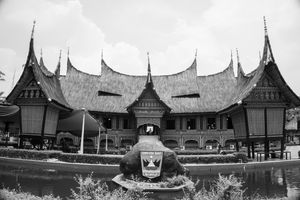
This transition from liquid to solid, from bright to dark, reflects the Minangkabau view of maturity. Life begins with the fluidity and brightness of youth, but through the heat of experience and the steady stirring of time, one is expected to become concentrated and resilient. A well-made rendang is not supposed to be soft like a western pot roast. It should have texture and resistance, requiring the eater to engage with the fibers of the meat. It is a food that demands attention, much like the intricate wood carvings on the gables of a traditional Rumah Gadang house.

A Legacy Preserved in Oil
In the modern era, where fast food and instant gratification have become the global norm, the six-hour commitment of rendang stands as a quiet rebellion. In Padang and the surrounding highlands, the tradition remains largely unchanged despite the advent of gas stoves and pressure cookers. Many families still insist on using wood fires, believing that the smoke of the cinnamon wood adds a final, essential ingredient that no modern appliance can replicate. The soot-stained walls of these kitchens are testaments to generations of women who have mastered the art of the slow burn.
To eat rendang is to participate in a history of migration and social philosophy. It is a dish that tells the story of a people who look at the horizon with ambition but keep their roots firmly planted in the traditions of the village. As the dark oil coats the palate, one senses the heat of the Sumatran sun, the shade of the coconut palms, and the steady, rhythmic movement of the wooden spoon against the iron wok. It is a reminder that the most enduring things in life are those that have been tested by fire and allowed to take their time.
As the final steam clears from the pot in that Bukittinggi kitchen, the result is placed into a ceramic bowl. It looks humble, almost charred, lacking the vibrant colors of a fresh salad or a quick stir-fry. Yet, within that dark exterior lies the collective wisdom of an entire culture. It is a dish that refuses to be rushed, a culinary anchor for a people who are always on the move, and a silent guardian of the Minangkabau identity.